Hair Care Guides

Start with the instructions you came home with.
Rebuild one complete wash that fits today.

After a hospital stay, the way you used to wash your hair might not work for now. Your reach, the position you can get into or the help around may all be different. Check your discharge notes, then plan one complete wash you can finish.

Your personal hair-care planProduct choices, routines and answers shaped around your hair.$49one-timeStart my consultation
An older woman reviews a home-information folder beside a towel, shampoo and comb.
Rebuild one complete wash that fits today.

What is going on

An adult points to a home-instructions page while a trusted person listens.

Find the instructions that touch hair care

Keep your discharge paperwork and the contact number together. Look for anything about washing, position, movement, dressings or devices. If hair isn’t mentioned, treat it as a question to ask, not as permission for your old setup. Feeling unsure here is completely normal.

A man seated at a dry dressing table with both forearms resting on a folded towel beside a mirror, comb and bottles.

Compare the whole task with what you can do today

Think through getting into position, wetting, applying, rinsing, drying and clearing up. A wash that starts fine can be hard to finish. Pick the part you can complete within your instructions, and arrange help for exactly the rest, no more.

What helps, day to day

An adult wearing a behind-the-ear hearing aid writes in a notebook beside an open booklet.

A dressing or device changes the route

  • Its own instructions decide what can get wet, how you position yourself and how you handle it.
  • Don’t take equipment off, rig up a waterproof cover or steer rinse water around a wound on the strength of a general hair guide.
  • If a normal wash is off the table, arrange something your instructions allow.
An adult gently holds loose lengths to observe their condition without pulling or working through a dense mat.

Your hair tangled while you were in

  • Check the lengths you can reach, gently, before you start.
  • A few loose tangles and a dense matted patch need different plans.
  • Don’t pull through anything painful, fixed or felted.
  • Get someone experienced to help with that, and don’t assume it has to be cut or that a product will undo every knot.
Two adults review a paper calendar at a kitchen table with closed care bottles and a towel nearby.

Someone can help with part of it

  • Agree what the helper does and where you’d like them to pause.
  • Share the written restrictions that matter and keep your own preferences in the conversation.
  • Having someone set out supplies or clean up afterward can be a real help, even when you’d rather do your own hair.
A woman returns a pale comb to a dark tray containing capped shampoo and conditioner bottles and a bowl of clips.

Keep the first attempt small

  • Put only what you need within the reach you’re allowed, with drying and clearing up already planned.
  • Keep the discharge contact handy for anything unresolved.
  • Styling can wait.
  • None of this changes the instructions you came home with.

Products, by the job they do

A woman massaging shampoo lather onto her scalp with her fingertips.

Choose a cleanser you can finish with

What matters is the wash access you’re allowed, how your scalp feels and the help you have. A hospital stay doesn’t change which shampoo suits you. Keep the rinse achievable, and don’t turn ordinary shampoo into something you leave in or wipe off.

Browse cleansing products. Bring the shampoos you are choosing between to the consultation, along with what you liked or disliked about them.

A woman smoothing conditioner through her mid-lengths and ends.

Condition within the plan

Use conditioner on the loose lengths you can reach, where your instructions allow it. Slip helps with tangles, but it never overrides a rule about a wound, a device or movement.

Browse rinse-out conditioners. Tell the consultation what you want from a conditioner and what you disliked about previous ones.

Getting ready for the next wash

A woman gently presses both hands against the outside of a fitted rinse-free shampoo cap.

1. A no-rinse cap, only if your instructions allow it

Only if your care instructions allow it, use a sealed, ready-made cap that says it works at room temperature. All your loose hair must fit, and you need to manage putting it on, working it through and taking it off. Follow its own restrictions too.

Guide: Use a room temperature rinse-free shampoo cap

When to get help

A woman and a medical professional seated together, looking at a calendar.

Signs that need more than routine care

  • If the instructions are unclear or you can’t manage at home, call the medical professional or discharge team named in your paperwork. That’s what the number is for, and asking early is easier than guessing. Follow the warning signs in your plan straight away, and treat a wound that gets redder, swells, leaks or hurts more, or a fever, as something for your team today, not a reason to change shampoo.

Illustrated care examples: before & after

Supplies beside the instructions

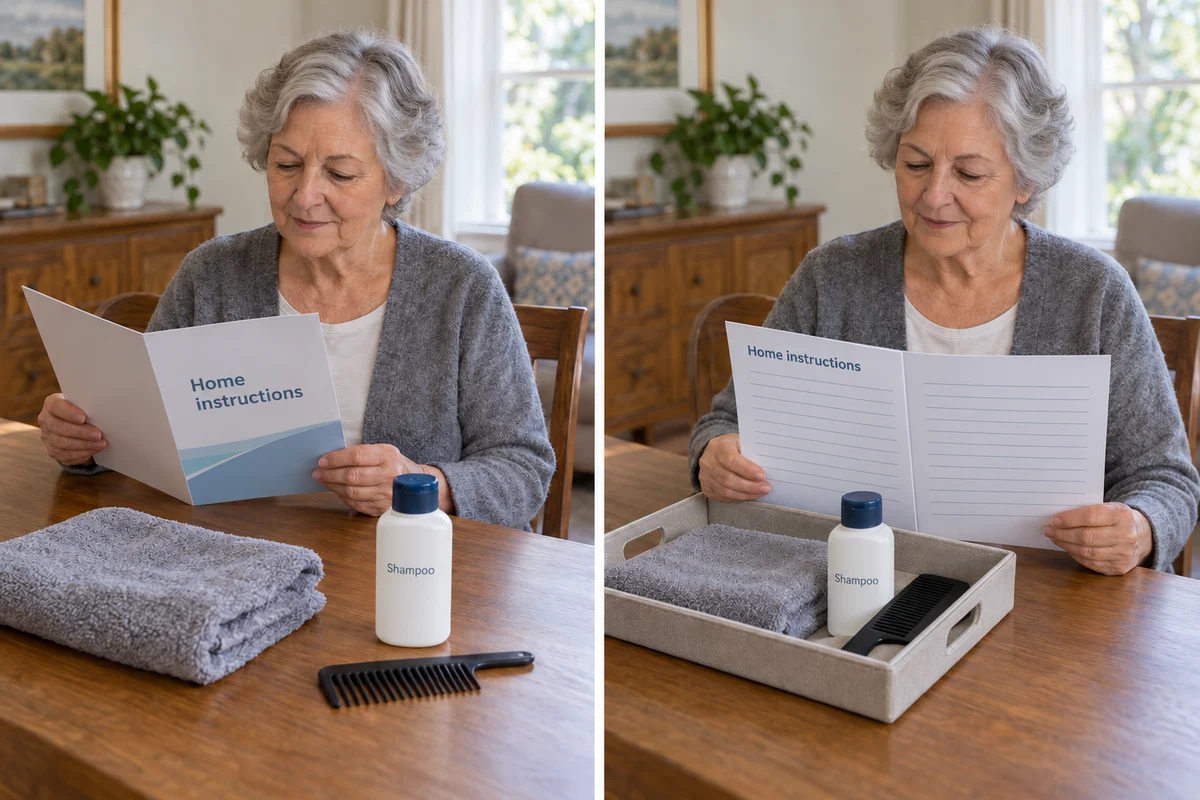
The same woman reviews an instruction folder as loose supplies are gathered into a reachable tray.
Before · supplies across the tableAfter care · supplies gathered by the instructions
Only the supplies your plan allows, gathered next to the written instructions. Whether washing is allowed yet is a question for that plan, not this picture.

One job for the helper

The same adult and helper move from an open notebook to a specific cleanup-help note.
Before · help not yet namedAfter care · a cleanup task agreed
The two of you settle on one job where a hand would help, clearing up afterwards. Your preferences stay in the plan, and nothing else has changed.
A woman with very short hair writing an appointment checklist.

Help with your hair-care routine

Bring your hair-care questions to the consultation. You can also read planning the complete care task around available energy.

  • Which of my discharge instructions affect washing and how I sit or lie?
  • Can I finish the whole wash, including rinsing and drying?
  • Which single step would be easier with someone’s help?

Tell us the restrictions you want respected, what washing access you have, how tangled your hair is and who can help. The plan adapts everyday care around those facts. It won’t change your discharge instructions or decide when a wound or device can get wet.

The Hair Care Consultation gives you a personal plan with product recommendations, routines and guidance on your hair-care questions.

$49 with 60 days of follow-ups, or $99 with 12 months. Pay once; the year renews only if you choose.