Your hair, through life

Hair changes in your 40s.
Care that changes with you.

Your familiar routine may not feel so familiar anymore.

A smaller ponytail. Drier ends. Hair that falls flat sooner. If you’re noticing a change before menopause, you deserve clear explanations and practical next steps.

Personalized hair-care guidance · $49.00 one-time

Two women in their 40s, one with loose waves and one with natural coils, talking together in daylight.
Every texture, every starting point. Images on this page are illustrative.
Understanding this stage

It can be a time of change. It isn’t the same for everyone.

Premenopause broadly means the time before menopause. Perimenopause is the transition leading up to it, often beginning in the 40s. Estrogen and progesterone fluctuate, and estrogen declines overall. Your age or hair alone cannot tell you which stage you’re in.[1]

Each follicle cycles through growth and rest. Hormones help regulate that cycle. Female pattern hair loss becomes more common around and after menopause, but genetics also matter and the hormonal link is not fully understood.[2] [3]

In female pattern hair loss, affected follicles produce progressively finer, shorter hairs. That can mean less coverage and a wider-looking part. This is different from a strand snapping along its length, and it cannot be diagnosed from your age.[7]

Not every change is hormonal. Illness, significant stress, weight loss and some medicines can cause shedding; heat, chemical processing and rough handling can contribute to breakage. More than one thing may be happening.[3] [5]

Start with what you’re noticing.

These clues help you describe a change. They don’t diagnose its cause, and short hairs can be new growth as well as breakage.

01 / Fullness

“My part looks wider.”

Gradually seeing more scalp or a smaller ponytail deserves attention. Fine strands and fewer strands are different things.

Notice where it’s changing and when it began. Speak with a medical professional about ongoing thinning.[2]

02 / Shedding

“There’s more hair in the shower.”

Shedding can increase months after an illness or stressful event. A wash-day count alone cannot tell you why.

Note the timeline, recent health or medication changes, and how long it has been since your last wash.[3]

03 / Feel & breakage

“My ends feel rough and tangle.”

Dryness, frizz and snapping call for a look at conditioning, handling and styling. They aren’t proof of a hormone change.

Notice where hair snags, which steps feel rough, and whether products leave the lengths soft or coated.[4] [5]

A formula should fit your hair’s needs today.

There isn’t one “over 40” shampoo everyone needs. Choose by the job: cleansing your scalp, easing tangles, conditioning your lengths or helping a style hold.

Cleanse without overdoing it

Comfortable scalp, less coated hair

A shampoo’s cleansing blend removes oil and residue. If lengths feel stripped, consider a gentler wash and concentrate shampoo on the scalp. A sulfate-free label alone doesn’t tell you how the whole formula will feel.[4] [6]

Condition for easier handling

More slip, less tugging

Conditioning agents such as behentrimonium chloride help strands slide past one another. Fatty alcohols such as cetyl and cetearyl alcohol add conditioning; they are different from drying alcohols. Formula balance and placement matter.[6] [8]

Match richness to your lengths

Softness without losing the lift you want

Silicones such as dimethicone can reduce friction and improve smoothness. Oils and richer creams can soften dry lengths, but may feel heavy on fine hair. Try less product or more targeted placement before replacing everything.[6]

Style for the finish you enjoy

Fuller-looking roots or more defined curls

Styling polymers in mousses and gels help hold a shape. A light mousse may suit root lift; a suitable gel can hold curl clumps. These are temporary appearance changes. Cosmetic products do not reverse hormonal hair loss.[6]

An ingredient list cannot establish the exact concentration or predict your result. Formulas change; check the label on your own bottle, especially for allergies and directions.

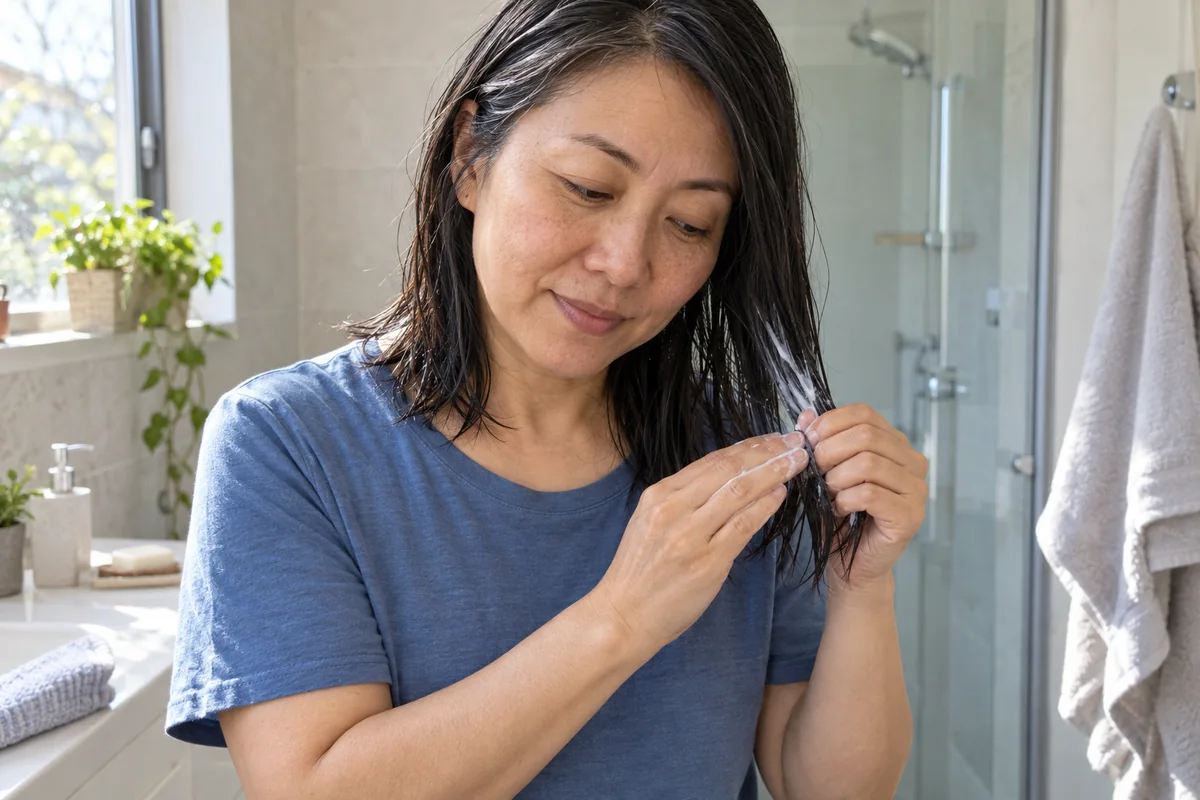
A woman in her 40s gently working conditioner through the damp ends of her straight hair at home.
Small changes in where and how you apply a product can matter.
Make everyday care gentler

Adjust a few steps. Keep it manageable.

  1. Wash for your scalp’s needs.Let oil, sweat and residue guide your schedule. Don’t stretch washes simply because you’re worried about shedding. Focus cleansing on your scalp.[4] [5]
  2. Put conditioning where it helps.Fine or straight hair may need it mainly at the ends. Dry curls and coils may benefit through the lengths. Follow your product’s directions. See the conditioner photo guide.[4]
  3. Reduce friction and tension.Work through tangles gently from the ends upward. Blot rather than rub with a towel, and keep styles comfortable instead of tightly pulled.[4] [5]
  4. Use less heat when you can.Reduce hot-tool frequency. When styling with heat, use a suitable protectant and the lowest effective setting. Protection doesn’t make repeated high heat harmless.[4] [5]

Our suggestion: change one manageable thing at a time. Note scalp comfort, tangling and how the style holds over a few washes. If tracking fullness, compare occasional photos with the same part, light and dry-hair state; photos cannot diagnose hair loss.

What cosmetic care can change

A different finish. Still your hair.

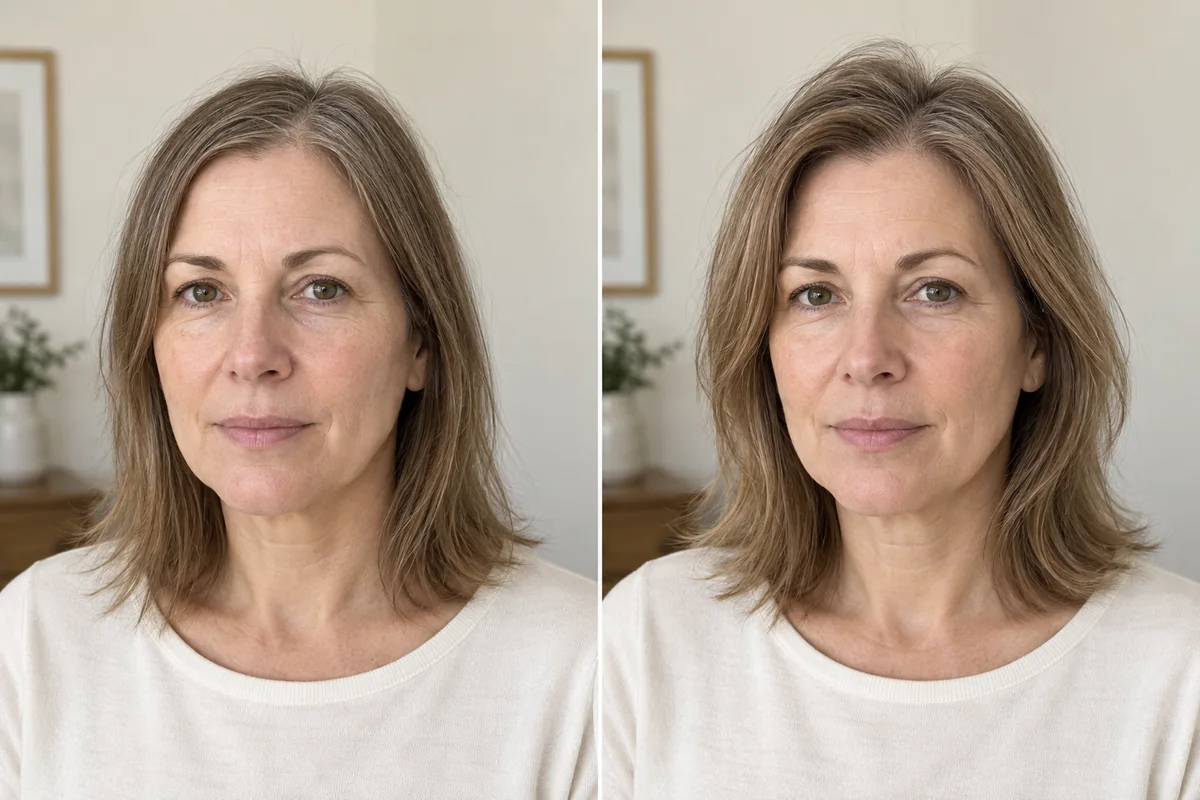
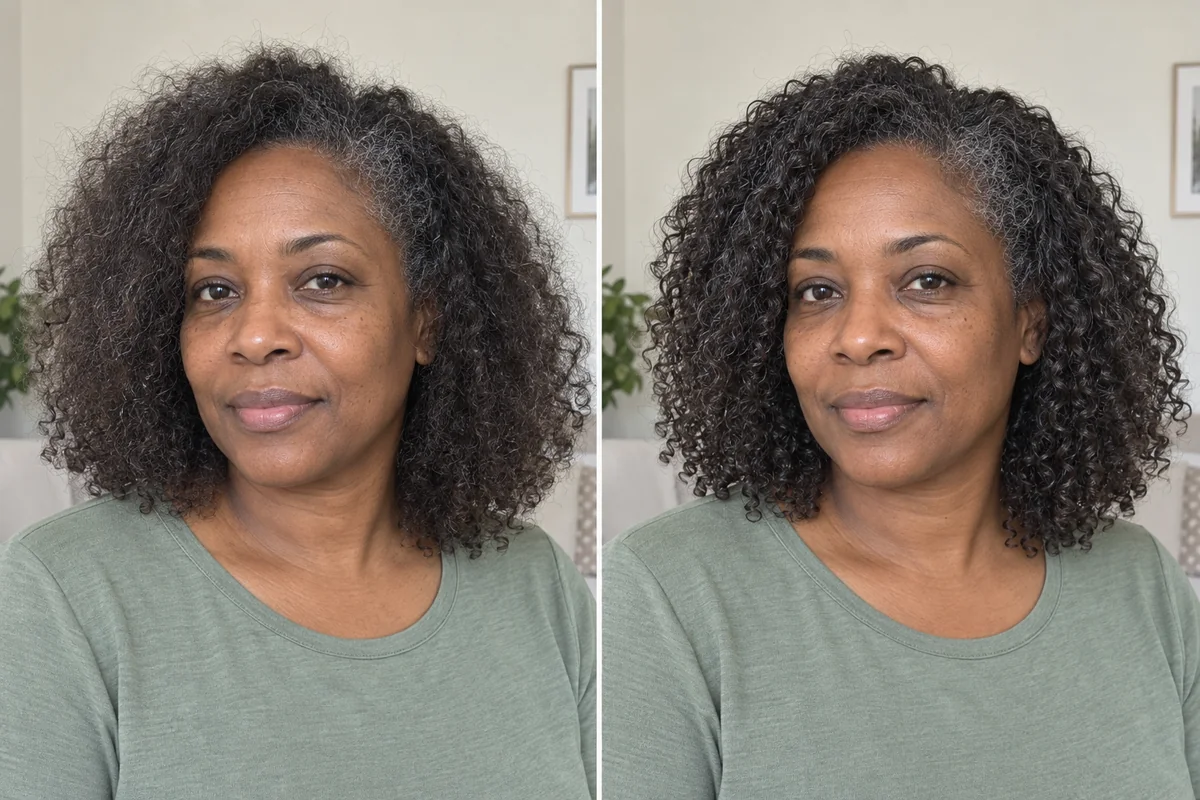
Illustrative before/after panels — not customer results. These created images show possible styling differences, not measured product effects, a promised outcome or new hair growth.

A little more lift

Illustrative comparison of the same woman with fine hair: flatter roots on the left and modest styling lift on the right; no regrowth is shown.
Before · flatter rootsAfter styling · light lift
The idea: lighter product placement and a suitable styling hold can change how hair sits. They do not add follicles or treat thinning.

A little more definition

Illustrative comparison of the same woman with natural curls: a fluffier finish on the left and more defined curl clumps on the right.
Before · softer, fluffy clumpsAfter styling · more definition
The idea: conditioning and styling can help curls group together. Both finishes are valid; choose the one you enjoy.

Questions you may be asking.

Does thinning hair mean I’m in perimenopause?

No. Hair changes alone cannot identify perimenopause or the cause of thinning. Cycle changes and other symptoms are useful context for a clinician, alongside your health history.[1] [2]

Can shampoo bring back the hair I’ve lost?

Cosmetic shampoo cleanses; styling can change the appearance of fullness. Neither is a substitute for assessment and treatment of hair loss. A medical professional can discuss treatments suited to the cause.[2] [5]

Should I take hair supplements or change my hormones?

Discuss these with a clinician. Supplements are not automatically helpful, and too much of some nutrients can worsen hair loss. Hormone treatment is a medical decision based on your individual health and symptoms.[1] [5]

Can I have dry ends and oily roots at the same time?

Yes. Your scalp and lengths can need different care. Cleanse based on scalp oil and residue, then adjust the amount and placement of conditioner for your lengths. You may not need an entirely new set of products.[4]

Your personal next step

Make your routine make sense again.

Tell us what has changed, what you use and what you’d like help with. Your Hair Care Consultation turns your answers into a practical plan.

  • Guidance for your supported hair-care concerns
  • Product recommendations with reasons they fit
  • Routines and techniques for your needs, preferences and budget
$49.00 one-time

Includes 30 days of answer edits and guidance updates from payment. No subscription or required product purchases.

Start my consultation

Based on your answers and our product data library. We do not physically test your hair or diagnose hair loss. Review the supported scope before payment.

By Hair You Love · Sources checked September 19, 2026
General cosmetic education; not a medical assessment.

Sources & editorial notes
  1. Office on Women’s Health: menopause basics
  2. American Academy of Dermatology: female pattern hair loss
  3. American Academy of Dermatology: shedding and hair loss
  4. American Academy of Dermatology: healthy hair care
  5. American Academy of Dermatology: caring for thinning hair
  6. Hair Cosmetics: An Overview — International Journal of Trichology
  7. British Association of Dermatologists: female pattern hair loss
  8. University of Virginia Chemistry: hair and hair care

Medical background is drawn from the sources above. Product-selection examples and the one-change-at-a-time approach are Hair You Love’s practical interpretation. Photographs are created editorial illustrations; no testimonials or clinical results are depicted.